“I am asking for help.”
A deliberately enrolled gesture or accessible manual SOS would take a priority route. A routine workout or a low heart rate must not suppress it.
 PULSE IQTECHNOLOGIES
Try the demos
An idea for intentional gesture SOS and contextual check-ins that would need careful evaluation. Hardware, firmware, apps and detection models are proposed future work; no product prototype is presented.
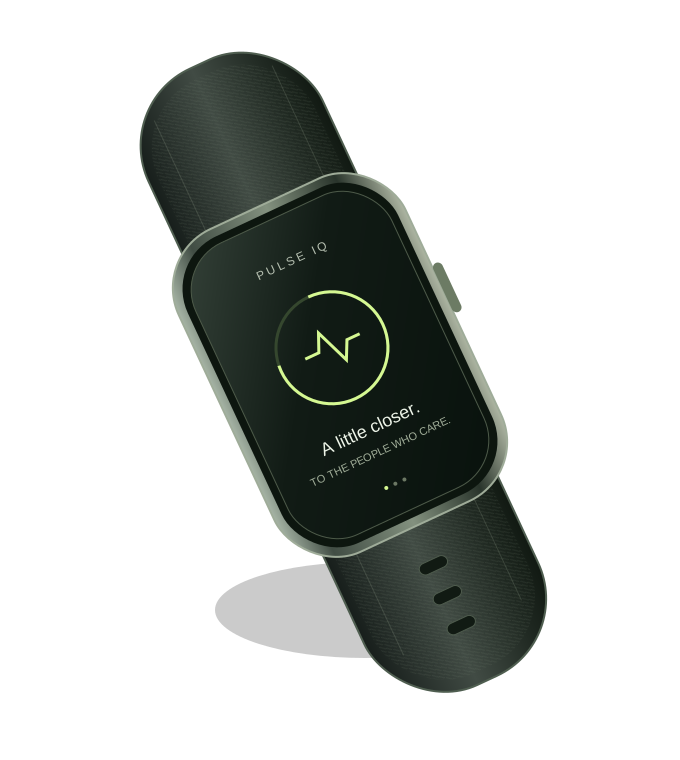 CONCEPT VISUAL · NOT A MANUFACTURED PRODUCT
A deliberately enrolled gesture or accessible manual SOS would take a priority route. A routine workout or a low heart rate must not suppress it.
Passive movement patterns are uncertain. Future sensor-quality checks and bounded check-ins could inform a response, but neither capability has been developed or validated for this idea.
Accelerometer and gyroscope data could describe acceleration and rotation. A compass adds heading; none alone gives reliable absolute position.
On-device inference and opt-in personalization are research ideas. A 30-day learning period is not validated, and any adaptation would need safeguards against normalizing repeated distress.
Phone-assisted location and communication are a candidate feasibility path. Standalone cellular operation would need separate hardware, network and power evaluation.
A proposed wrist-worn device combining motion sensors, haptics and phone connectivity. Custom firmware or an embedded operating system would be selected after feasibility work.
Battery life, water resistance, sensing rate and enclosure design are unverified engineering targets.
The idea proposes normal-use location intervals from 5 minutes to 2 hours, with a 15-minute default. An opt-in journey could request more frequent updates, route context and an ETA; an incident could request the freshest available location. None is implemented as a safety service here.
Every location must show timestamp, uncertainty and connectivity status. Indoor positioning, tunnels, network loss and battery limits can prevent fresh updates. Reaching a destination alone must not close an active incident.
| Capability | Current status | What must be established |
|---|---|---|
| Deliberate gesture SOS | Proposed | Gesture recognition, accidental-trigger tests and an accessible manual fallback. |
| Passive incident check-ins | Research question | Consented data, target-event definitions and false-positive/false-negative validation. |
| Location and journey mode | Proposed | Supported phone/GNSS permissions, route and ETA estimates, fix age, uncertainty and power budget. A route deviation or arrival must not establish danger or safety by itself. |
| Trusted-contact alerts | Proposed | Recipient consent, notification delivery, acknowledgements and cancellation updates. |
| Police / responder console | Not integrated | Authorized partnerships, jurisdiction routing and operating agreements. |
| Standalone cellular operation | Hardware option | Modem, network support, antenna, subscription and runtime testing. |
| Wellness features and custom firmware | Candidate scope | Hardware platform, sensor quality, feature scope and maintenance plan. |
| Existing watch integration | Compatibility unverified | Vendor APIs, permissions, background execution and supported-device testing. |
| User-controlled standby | Proposed control | Clear paused status, accessible confirmation and secure setting changes. Any explicit SOS path depends on powered, supported hardware and connectivity. |
A future wearer app could enrol a gesture, manage contacts and sharing, and offer safety confirmation. Accessibility, cancellation and anti-coercion controls would need dedicated evaluation.
A future contact app could show a notification, location age and an acknowledgement option. No such app is available; acknowledgement would not establish safety or completed assistance.
A future console could support case context and incident coordination. It requires a legitimate integration; no police app, dispatch or officer assignment exists today.
Confirm the supported hardware, phone, permissions and connection requirements.
Invite consenting contacts and agree what they should do when an alert arrives.
Practice a supported SOS gesture and cancellation flow safely, without contacting emergency services.
Choose time-limited sharing and understand when location is available or stale.
Make battery, connectivity, sensor status and unacknowledged incidents visible.